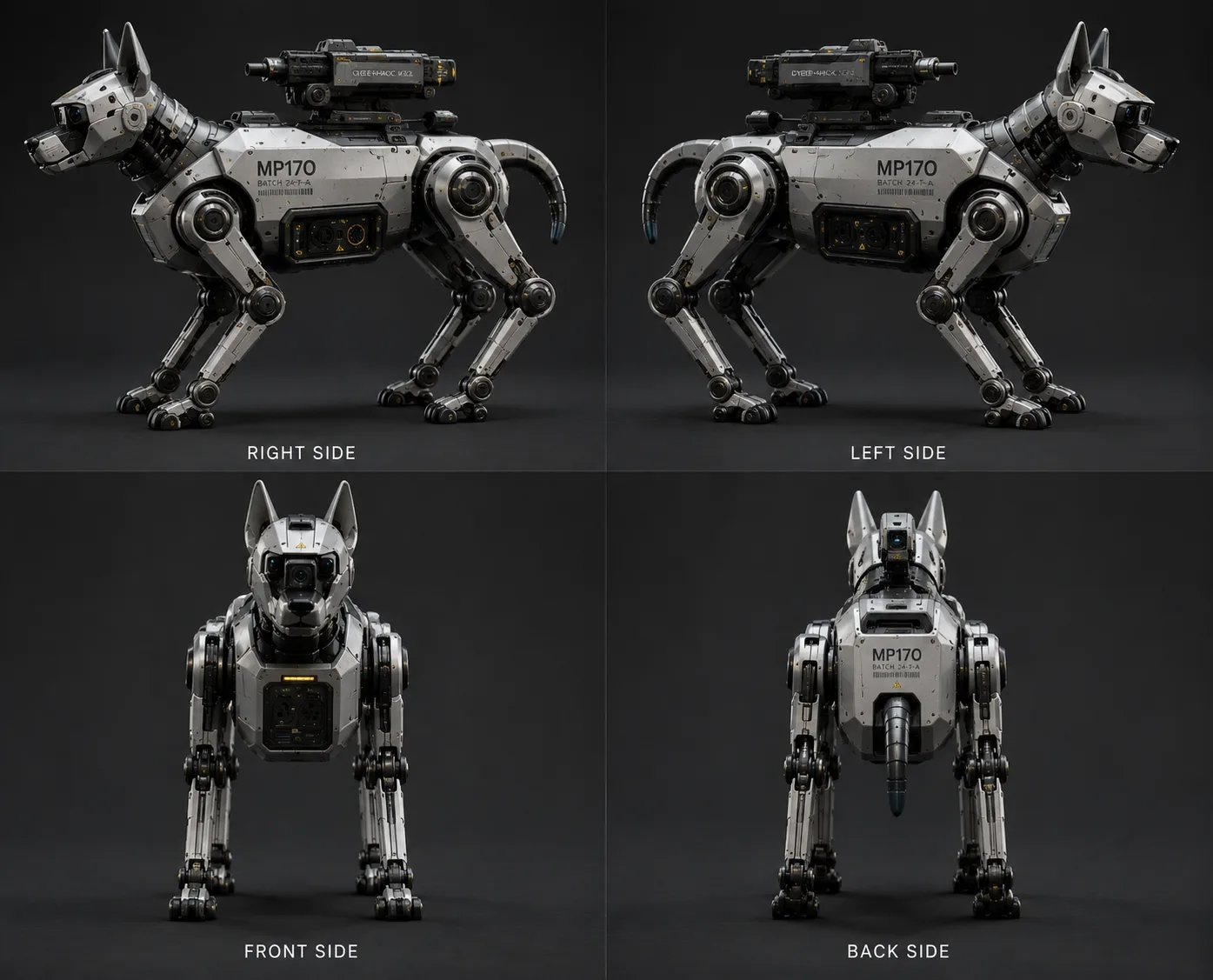
MP-170 carries no dead weight — the program's power and mass budget is tight enough that every gram on the chassis has to justify a mission-critical function. This is what each system does, and why it's built that way.

Three lenses share the same head. A thermal sensor picks out a body behind cover before it's visible to the eye. An ultra-zoom camera confirms who or what it is from a distance that keeps MP-170 out of easy range. A third lens feeds a live satellite relay, so command sees exactly what the unit sees — not a report filed after the patrol gets back.

A single port does two jobs. In friendly territory, it delivers 250 watts to charge allied electric vehicles in the field — no need to route them back to a depot. Pointed at a small-scale hostile system instead, the same port can push a disabling short-circuit pulse into it, taking a low-grade enemy defence system offline on contact.

Mounted above the shoulders, this unit blankets a 50-yard radius with interference tuned against medium-strength defence electronics. It doesn't destroy anything — it degrades an opponent's sensors and triggers just long enough for a patrol to close distance or withdraw clean, before the other side works out what happened.

The tail most people would dismiss as cosmetic is a tuned antenna. It keeps a continuous link to satellite coverage overhead, which does two things at once: it tells command exactly where MP-170 is at all times, and it relays what MP-170's own sensors have located — including positions the unit has flagged as hostile.

India's terrain doesn't hand out easy postings. The same program has to survive a Thar sandstorm, a Western Ghats landslide season and a Himalayan freeze — often within one deployment cycle. The alloy shell is built to that range, not to a single climate, so a unit doesn't need to be swapped or specced per region.

The chassis reads outside temperature and adjusts on its own. In a Himalayan freeze it vents heat through internal channels to keep joints and optics from icing over. In desert heat it draws in cool air to keep onboard electronics inside their operating range. No manual mode-switching, no external units to bolt on before a deployment.

Wheels and treads fail on India's harder ground — deep snow, loose scree, sucking mud. A canine gait spreads MP-170's light weight across four points of contact, letting it cross snowpack that would swallow a wheel and pick a line through terrain a vehicle would have to route around entirely. The same lightness that helps it cross snow also keeps its footfall quiet enough to close on a position without announcing itself first.
| System | Designation | Key spec | Function |
|---|---|---|---|
| Eyes | Trinetr Array | 3 fused feeds | Thermal, ultra-zoom, satellite-relay optics |
| Belly port | Vajra Port | 250W | EV charging / disabling short-circuit |
| Spine unit | Mayajaal Jammer | 50 yd radius | Soft-kill jamming, medium-strength systems |
| Tail | Nakshatra Uplink | Continuous link | Satellite antenna, position + hostile relay |
| Body | Kavach Shell | Multi-terrain rated | Storm / landslide / freeze-rated alloy armor |
| Climate control | Prakriti Regulator | −30° to 55°C | Automatic heat venting / cool-air draw |
| Mobility | Chhaya Gait System | Lightweight quadruped | Snow, scree, mud traversal, low-signature gait |